


Read time: 3 mins
Author: Charlie Martin
Labelling a brand as “greenwashing” because it failed to explain the nuance of its sustainability work in a 30-character Google Ad is, frankly, wild.
Yet that is effectively the precedent being set by recent advertising rulings. Not because brands were inventing claims or misleading consumers, but because the evidence did not sit inside the ad itself.
This matters. Not just for marketing teams, but for sustainability leaders, legal teams, and anyone responsible for publishing claims in 2026 and beyond.
The problem is not false claims. It is the format.
In recent rulings involving Nike, Lacoste, and Superdry, the core issue was not a lack of evidence.
These brands had the receipts. They had the data. They could substantiate their claims.
The problem was where that substantiation lived.
Under current enforcement logic, particularly as applied by the Advertising Standards Authority, if proof is not presented within the ad itself, the claim may still be treated as misleading. This is true even when ads are delivered dynamically, character limits prevent meaningful explanation, and advertisers do not control placement or surrounding context.
In short, context does not count unless it fits inside the ad unit.

Why this standard breaks down in digital advertising
Digital advertising was never designed for nuance.
Search ads, social placements, and programmatic formats prioritise brevity, automation, and speed. They do not prioritise layered explanation. Sustainability claims, by contrast, require scope, boundaries, definitions, and acknowledgement of trade-offs.
Trying to compress that into a headline or short line of copy is not just unrealistic. It actively discourages responsible communication.
This problem intensifies when AI-driven monitoring systems flag terms such as “green”, “eco”, or “sustainable” without understanding intent, qualification, or evidence.
The chilling effect on sustainability communication
The result is a growing fear across organisations.
Say too little, and progress goes unrecognised. Say too much, and invite scrutiny. Say anything at all, and risk being accused of greenwashing.
This does not improve accountability. It suppresses transparency.
Increasingly, sustainability teams advise marketing colleagues to avoid sustainability language altogether. Not because the work is not real, but because the rules reward silence over clarity.
That is a failure of the system.
Accountability should not depend on ad character limits
Holding brands to account matters. Consumers deserve clarity, honesty, and evidence. But accountability should be based on whether a claim can be substantiated, not whether it was fully explained inside a format never designed for depth.
A more credible standard would ask:
-
Is the claim supported by verifiable evidence?
-
Is that evidence publicly accessible?
-
Is the language proportionate, specific, and not overstated?
-
Is additional context clearly signposted?
This is where current enforcement falls short.
Transparency Reports as the missing layer
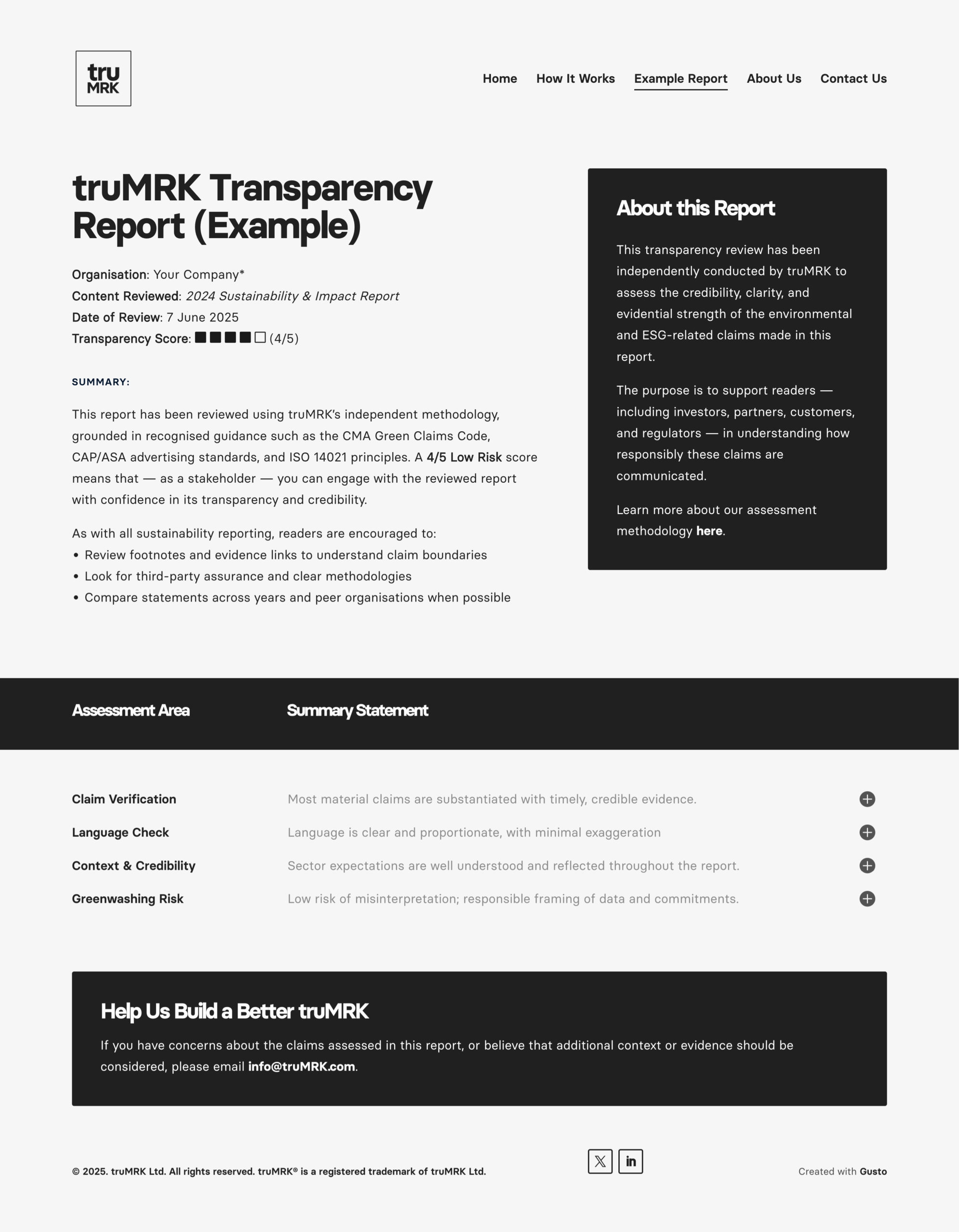
Rather than forcing every claim to stand alone, Transparency Reports offer a practical countermeasure.
They provide a public, claim-specific explanation of evidence, scope, and limitations. They define what terms such as “sustainable” actually mean in practice. They disclose what the claim does not cover. They remain available long after an ad campaign ends.
Most importantly, they allow brands to link from constrained formats, such as ads, to fuller context without diluting creative or resorting to vague language.
Liberating creative without lowering standards
When brands have a credible, independent way to show their working, they gain permission to communicate responsibly.
They can use sustainability language without fear. They can explain progress without oversimplification.
They can reduce legal and reputational risk. They can give regulators and consumers what they actually need, which is context.
This is not about finding loopholes. It is about aligning accountability with how digital communication actually works.
What this signals for 2026 and beyond
As scrutiny increases and automated monitoring becomes more aggressive, the brands that succeed will not be the quietest. They will be the clearest.
That means moving beyond ad-level compliance towards publication-level transparency.
If the goal is to reduce greenwashing, the answer is not fewer claims. It is better-supported ones.
At truMRK, this is the gap we exist to address. We review draft sustainability communications, assess evidence and language risk, and issue public Transparency Reports that give claims the context ads never can.
Because credibility should not depend on how many characters you are allowed to use.
Strengthen Your Communications
truMRK independently reviews sustainability reports and communications, helping organisations publish with clarity and confidence.