Read time: 2 mins
Author: Charlie Martin
Where It Started
In September 2021, the UK’s Competition and Markets Authority published its Green Claims Code. This followed an international review which found that up to 40% of environmental claims made online could be misleading. The CMA indicated that enforcement would begin the following year.
For the construction sector, where Charlie Martin‘s agency Gusto had spent years working on sustainability communications, this signalled a clear shift. Genuine environmental progress was being made across the industry, but the governance behind how that progress was communicated had not kept pace with regulatory expectations.
In response, Charlie launched The Anti-Greenwash Charter in 2022. It is built around four standards: transparency, accountability, fairness, and honesty.
Its purpose was to give organisations a proper structure behind their sustainability claims, and to reduce their exposure to the CMA’s review.
What the Charter Checks
The Charter’s role is to verify governance. To become a signatory, an organisation undergoes a review of its regulatory history, public reputation, and current practices. It then develops a Green Claims Policy setting out its approach to sustainability communication. Staff complete greenwash awareness training. Periodic reviews follow, to confirm the organisation continues to adhere to its own policy.
Once approved, a signatory earns recognised status and a Charter logo for use on its materials. Some have used that status successfully in tender processes.
The Charter has consistently positioned itself as a companion to certifications such as B Corp, rather than a substitute. B Corp assesses a business’s overall impact. The Charter adds a further layer, focused specifically on how that business communicates.
What Signatories Began Asking For
As the Charter grew, a consistent request emerged from its signatories. A Green Claims Policy set out how an organisation intended to communicate responsibly.
What signatories increasingly wanted was a way to confirm whether that intention was being met, not through an annual review, but on the specific report or campaign about to be published.
This was not a request for further governance review. It was a request for verification at the level of individual content: one campaign, one report at a time.
This need came from organisations that had already done the foundational work: developing a policy, training their teams, and seeking the same rigour applied to what they were actually publishing.
Where We Fit
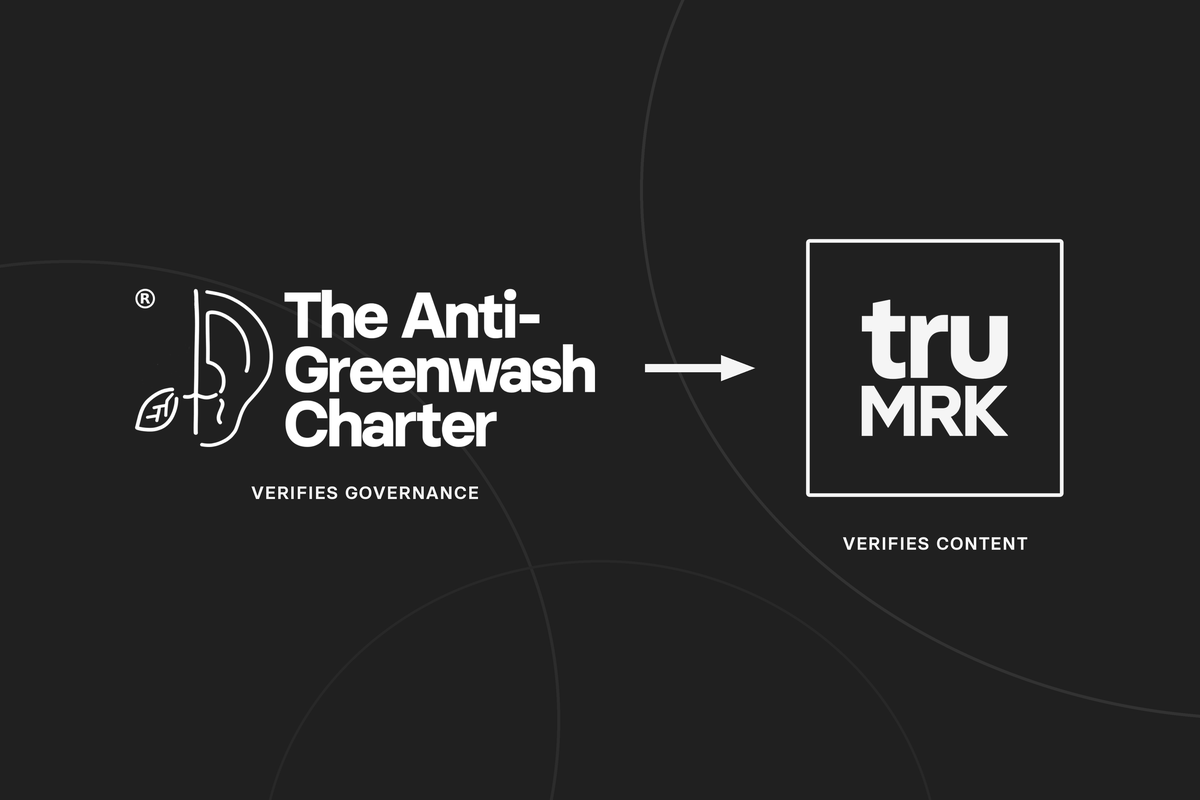
truMRK was built directly in response to that need. Where the Charter verifies that an organisation’s governance is in place, we verify individual campaigns, reports, and pieces of content against that same standard, one at a time.
Each piece of communication that scores about our threshold receives a truMRK badge, linked to a public Transparency Report. That report sets out what was claimed, what evidence supports it, how credible that evidence is, and where any gaps remain.
Every review is checked against the CMA’s Green Claims Code, ASA/CAP advertising standards, and frameworks including ISO 14021 and GRI.
The Same Principle, Extended Further
The Charter was built to address two needs for its signatories at once: reducing the risk of getting a claim wrong, and providing recognition for getting it right.
truMRK exists to extend that same principle further, to the level of individual reports and campaigns, rather than confining it to an annual policy review.
Strengthen Your Communications
truMRK independently reviews sustainability reports and communications, helping organisations publish with clarity and confidence.