
Read time: 3 mins
Author: Charlie Martin
Your Certification Is Only as Strong as Your Next Claim
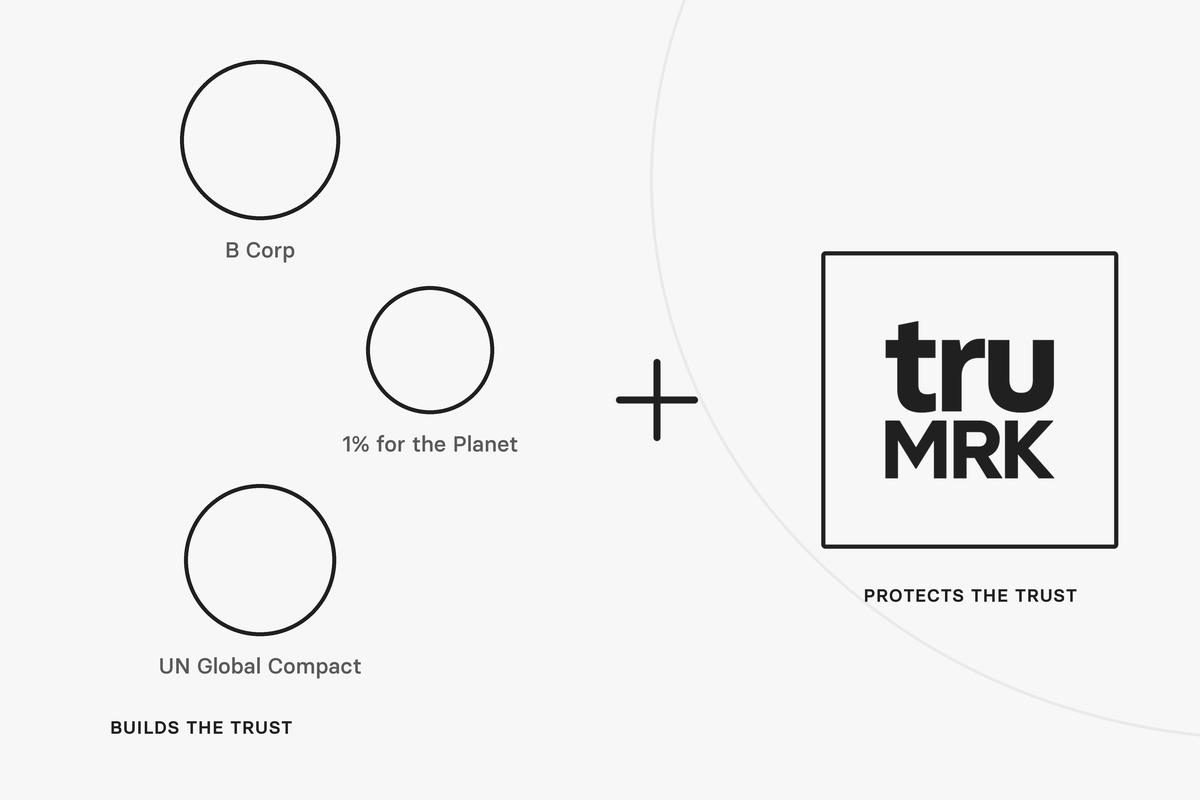
B Corp, 1% for the Planet, the UN Global Compact: these marks tell stakeholders that a business is, on the whole, the kind of organisation that can be trusted.
That’s genuinely valuable, and genuinely hard-earned. But that trust isn’t self-sustaining. It gets spent, claim by claim, every time the business communicates.
It only takes one exaggerated, unsubstantiated, or misleading claim to undo a share of the credibility the certification took months or years to build.
What General Marks Actually Do
General ESG marks have always been about one thing: signalling that a business is, on the whole, trustworthy and responsible.
B Corp is the clearest example, alongside marks like 1% for the Planet, which signals an ongoing environmental commitment, and the UN Global Compact, a membership pledge to a set of principles that’s largely self-reported.
What they don’t do is check any individual claim. The certification is awarded once, then renewed periodically. The claims a business makes happen constantly, in every report, campaign, product page, and social post.
The mark vouches for the business in general. It says nothing about the specific thing you publish next week.
The Trust You’ve Earned Isn’t Self-Sustaining
Here’s the risk that sits underneath every certified business: stakeholders, journalists, regulators, and activists don’t neatly separate “the certified part” of a business from “the claim that turned out to be wrong.”
When a certified B Corp gets caught making a misleading claim, the story isn’t “an isolated comms error.” It’s “certified B Corp misleads customers,” and the certification itself becomes part of the headline.
The reputational cost of one bad claim can outweigh the goodwill the certification generated in the first place, precisely because the certification raised the bar of trust stakeholders expect the business to meet.
This is the gap general marks were never built to close. They tell people you’re trustworthy in principle. They don’t verify that you’re being accurate in practice, claim by claim, in real time.
Where truMRK Fits: Protecting the Value You’ve Already Built
This is where comms verification earns its place, not as a substitute for certification, but as the layer that protects what the certification is worth.
truMRK checks a report or piece of communications from three angles.
First, substantiation: are the claims backed by evidence, and ideally, has that evidence been verified by a reputable third party, rather than resting solely on the organisation’s own reporting.
Second, regulatory language alignment: checking the wording used throughout against the standards relevant to the business’s markets, such as the CMA’s Green Claims Code or the ASA’s CAP guidance in the UK.
Third, context: confirming the content isn’t misleading by omission, that no contextual or material fact has been left out which, if included, would change how a reader interprets it.
Only once a piece of communications clears all three does it count as verified.
None of that replaces what a certification does. It closes the gap a certification was never designed to cover: the accuracy of what gets said in the certification’s name, every time the business speaks.
Not Every Mark Needs This the Same Way
Some marks aren’t reputational at all. They measure something specific, a measured environmental outcome, a scientifically validated target, an audited fact about how or where something was made.
These marks and verified communications aren’t competing for the same job, they’re feeding into each other: the measurement gives you something true to say, and verification confirms you’ve said it accurately, in the right terms, with nothing material left out.
The stronger the underlying data, the more verified communication has to work with.
Regulation Raises the Stakes for Everyone, Certified or Not
This isn’t just a reputational risk. The EU’s Empowering Consumers for the Green Transition Directive, applying from September 2026, bans vague environmental claims unless they’re backed by evidence.
In the UK, the CMA’s Green Claims Code and the ASA’s CAP guidance already apply the same logic to environmental and social claims specifically. None of these regimes care whether the business making the claim holds a certification. A B Corp can still fall foul of the Green Claims Code.
Certification builds trust with stakeholders; it doesn’t create a compliance exemption. The verification layer is what closes that gap, regardless of what mark sits on the letterhead.
The Missing Piece, Not a Replacement
None of this is an argument against certification. It’s an argument for recognising what certification alone can’t do.
A B Corp badge, a 1% for the Planet commitment, a UN Global Compact membership: these are real assets, and they deserve to be protected rather than left exposed to the next claim that goes out the door unchecked.
Verified communication is what lets a business actually realise the full value of the certifications and initiatives it’s already invested in, by making sure nothing it says next quietly spends down the trust those marks took years to earn.
Strengthen Your Communications
truMRK independently reviews sustainability reports and communications, helping organisations publish with clarity and confidence.