
Read time: 4 mins
Author: Charlie Martin
What General ESG Marks Actually Do
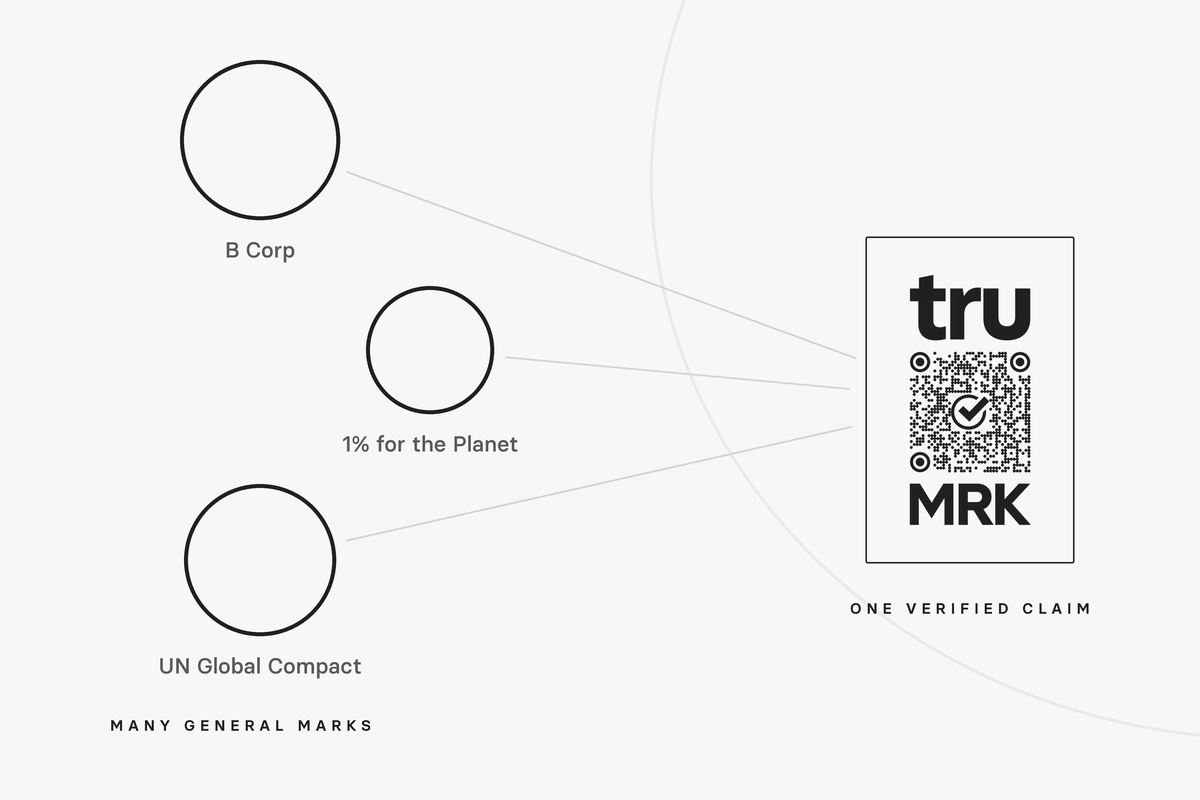
General ESG marks have always been about one thing: signalling that a business is, on the whole, trustworthy and responsible. They don’t check individual claims. They vouch for the business as a whole.
B Corp is the clearest example, alongside marks like 1% for the Planet, which signals an ongoing environmental commitment rather than verifying any one claim, and the UN Global Compact, a membership pledge to a set of principles that’s largely self-reported rather than independently checked claim by claim.
Before comms could be verified directly, that mattered. If a stakeholder couldn’t check a specific claim, the mark was the next best thing: proof that someone, somewhere, had assessed the business and found it credible.
Stakeholders extended that credibility to whatever the business said afterwards.
What’s Changing
That’s changing. Services like truMRK verify comms directly, at the point they’re published, rather than vouching for a business in general. If a specific claim can be checked, stakeholders no longer need to infer trust from a general mark. They can check the claim itself.
truMRK checks a report or piece of communications from three angles.
First, substantiation: are the claims made within it backed by evidence, and ideally, has that evidence been verified by a reputable third party, rather than resting solely on the organisation’s own reporting.
Second, regulatory language alignment: checking the wording used throughout against the standards relevant to the business’s markets, such as the CMA’s Green Claims Code or the ASA’s CAP guidance in the UK.
Third, context: confirming the content isn’t misleading by omission, that no contextual or material fact has been left out which, if included, would change how a reader interprets it.
Only once a piece of communications clears all three does it count as verified.
The Real Cost of Earning a Mark
Earning a mark like B Corp isn’t quick or cheap. It takes months: gathering documentation, coordinating people across departments, submitting evidence, waiting on review. B Lab’s standards, currently being overhauled through 2026, are becoming more demanding, not less.
All of that effort goes into a single overall verdict about the business. None of it verifies whether any specific claim made afterwards is true, correctly worded, or fairly framed.
So there’s a real choice available now. A business can keep spending that time, money, and energy earning a general mark. Or it can have its comms verified through a process like truMRK’s, and put that time, money, and energy back into the work the mark was always meant to reflect: actually improving the business.
Where This Doesn’t Apply
This doesn’t apply to every certification. Some marks aren’t reputational at all, they measure something specific that comms verification can’t replace: a measured environmental outcome, a scientifically validated target, an audited fact about how or where something was made.
None of these are made redundant by truMRK, if anything, they matter more, since a claim needs solid data behind it before substantiation, wording, or context can even be checked.
The distinction that matters, then, is simple: does the mark tell stakeholders “trust this business in general,” or does it verify a specific fact a claim can’t verify on its own? Only the first is displaced by direct comms verification.
Regulation Is Pushing the Same Way
The EU’s Empowering Consumers for the Green Transition Directive, applying from September 2026, bans vague environmental claims unless they’re backed by evidence.
The requirement isn’t to hold a general mark of good character, it’s to be able to prove what was actually said, in the right terms, with the full picture attached.
That’s exactly the ground truMRK’s process is built to cover.
A Reallocation, Not a Retreat
Strengthen Your Communications
truMRK independently reviews sustainability reports and communications, helping organisations publish with clarity and confidence.